Honoring Imelda Delchambre

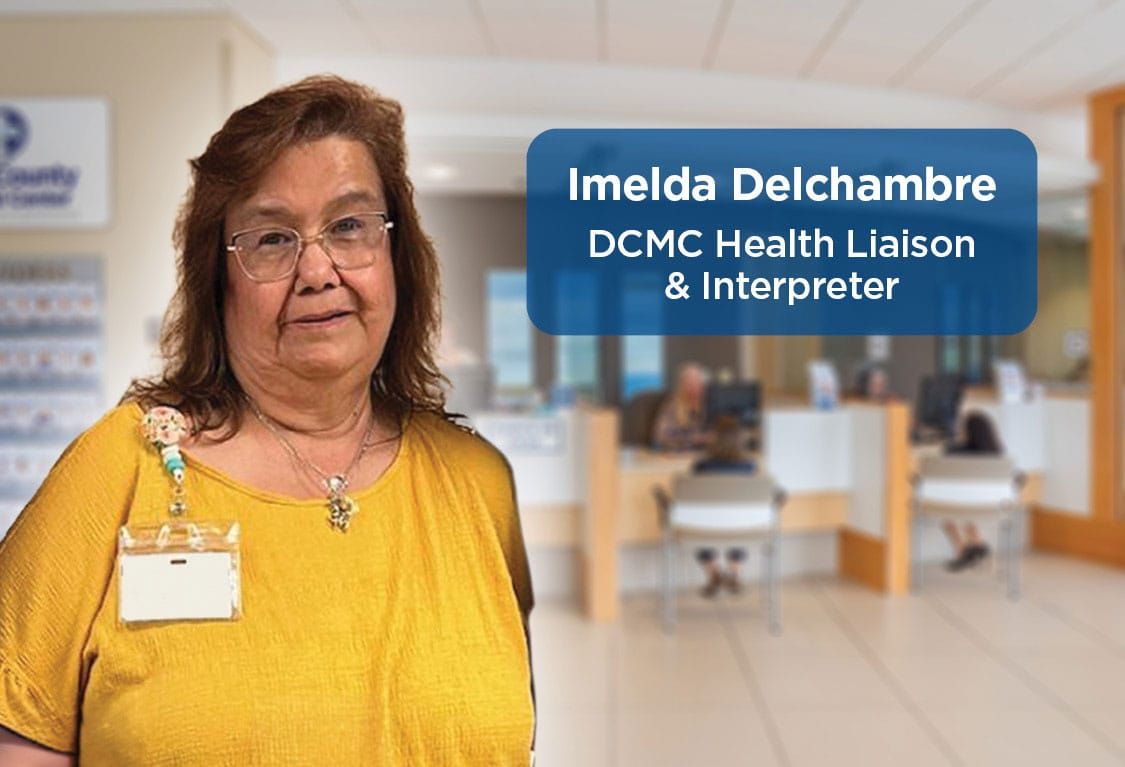
The interview for this story with Imelda Delchambre, Health Liaison and Interpreter for Door County Medical Center (DCMC), started a little late—but perfectly consistent with Imelda’s character.
She had been assisting a Spanish-speaking family at a medical appointment when rain began falling steadily. With no car and a long walk ahead of them, Imelda insisted—schedule aside—that she and her husband drive the family home.
That is who Imelda Delchambre is. She generously puts others' needs before her own whenever she is able and for as long as she possibly can. She answers her phone at all hours of the night and she considers herself on call 24-7, even when she is recovering from her own surgery.
At 73 years old, Delchambre has been working for DCMC for 29 years. Her job is to reach out to people in our community struggling with poverty and language barriers that prevent them from getting the care they need and making sure they get it. Her interventions have saved countless lives.
According to Brian Stephens, CEO of DCMC, ““I can’t think of many people who have had more of a direct impact on their friends and neighbors than Imelda Delchambre. From helping people set up medical appointments to providing transportation to linking folks to much needed resources, Imelda has dedicated her life to helping others, and our community is so much better for it.”
While her work with DCMC accounts for over a third of her life and accomplishments, her story begins much earlier.
Real American Roots
The story of Imelda Delchambre is a true American story. Delchambre was born in 1953 of Hispanic origin in Laredo, Texas to a working-class, Catholic, mixed-race, bi-lingual family.
She was born to Amador and Abigail (Castro) Estrada; the second oldest of 8 siblings. While they struggled financially, their family was rich in values. She was taught that there are always people less fortunate than her and that she should do everything she can to help them.
Imelda’s father, Amador, was born in Mexico and she traveled with him across the border on occasion to visit family. She recalls a trip with her father when she was six years old. At this particular border crossing there were usually people asking for money on the side of the road. Even though their family was poor themselves, her father handed Imelda change to give them. Imelda recalls the sense of fulfillment this act of generosity gave her and notes this as the foundation of her generous spirit.
Imelda Delchambre married young. Her husband was a migrant worker - a job that took them all over the country following the harvests. They traveled to Ohio to harvest tomatoes, Minnesota to harvest sugar beets, Florida to harvest citrus and Door County, Wis. to harvest cherries and apples. As a young person, it was exciting to see the country.
Her first daughter, Abigail, was born in Laredo, Texas. Then, in Minneapolis she gave birth to her second - a son, Gerardo Reyes. In October of 1972, her third child and second son, Leopoldo Reyes, was born at Door County Memorial Hospital. Her fourth child, Jose Reyes, was born in Florida.
After the birth of her fourth child, she and her husband divorced. Life had been hard for them and they grew apart. While her now ex-husband continued life on the road, Imelda stayed in Florida. She found work as a deputy Sheriff and interpreter for the Pasco County Sheriff’s Department and focused on raising her children, but memories of Door County flourished into fantasies of a life in what she considered paradise. In 1988, she and her four children made the move.
All four of her children graduated from Sturgeon Bay High School.
One day, in 1990, when she was working at a nursing home in Sister Bay, a co-worker convinced her to go out for a drink after work. She had never been in a bar before - surprising for a grown woman in Door County, but culturally it was a threshold that was not often crossed. She was giddy and nervous as they stepped through the door of Greystone Castle in Sturgeon Bay.
It was that night at Greystone Castle that she caught the eye of her now husband, Ernest. When asked, Ernest relays the story a bit differently, “I was hustled!” he says in loving jest.
Ernest and Imelda fell hard. Imelda: full of energy, a zest for life, a big family and vibrant penchant for righting the wrongs of injustice; and Ernest: hard working, resourceful, devoted and calm began to create a life of fulfillment, vibrance, faith and love. A life of service to those less fortunate than them.
Bridging the gaps
Imelda was recruited to begin working for a temporary clinic set up on DCMC property to serve the Spanish speaking population and in 1997 was asked by DCMC to serve as the Health Liaison and Interpreter for Door County Medical Center where she still serves today.
As the Health Liaison and Interpreter, she helps people navigate the medical system and provides interpretation services at appointments and during procedures (like labor and delivery), interprets test results and acts as a steward for the ebbing and flowing Hispanic population in Door County.
At the time of this interview (11 a.m., well, 11:20 a.m. on a Wednesday) she had already touched the lives of three people.
If you have ever had the experience of having a medical issue pop up, but had a barrier like, language, lack of insurance, or no way to get to a medical facility you might understand the sense of fear, vulnerability and frustration people in our community can face. Imelda is the person that eases that burden and gets people the care they need.
Imelda met Allin Walker in the mid-nineties through her advocacy work at HELP of Door County where he encouraged her to reach out to more hispanics and this work led into the development of the Hispanic Resource Center.
In 1998, Imelda, with the help of Allin Walker, Esther Weatherst, Father Bill Ribbens (of the Catholic Diocese in Green Bay) and esteemed colleague Robert Cueller, established the Hispanic Resource Center of Door and Kewaunee County.
They started out going door to door. Originally, the reactions were mixed. Some people thought they were immigration officers coming to take them away. Over time, Imelda, as she is known to do, built trust. They met with people in their backyards, and listened to their needs and desires.
The goal of the Hispanic Resource Center was established to provide a bridge between the two cultures. In addition to offering vital services to area Hispanics, the organization organized festivals with food and dancing to celebrate Cinco de Mayo (May 5), Mexican Independence Day (September 16), and the Virgin of Guadalupe Feast Day.
Over time, the Hispanic Resource Center leaders retired and passed away, but the need was still there.
The Latinos Emergency Assistance Fund (LEAF) at Hope United Church of Christ in Sturgeon Bay was established to raise funds for the Imelda’s Hope Fund (so named in 2024) to build community awareness and provide volunteer support. The services of the fund focus on meeting basic needs and supporting overall well-being including transportation assistance and financial assistance for Latinos in Door and Kewaunee counties.
Imelda is deeply ingrained in many area churches and places of worship, though she attends St. Joseph’s Catholic Church in Sturgeon Bay and the Catholic Diocese still makes a contribution to LEAF every two years. Imelda is still in charge of executing the fund. She often writes a check for people in need on the spot and then the fund reimburses her.
Barriers, what barriers?
For most people things like cancer or a heart attack would mean the work stops - at least for a time. When Imelda was asked about some of the barriers she has faced, it almost seemed as if they have had no effect on her at all.
For example, three years ago, Imelda had a heart attack while she was assisting someone in labor. She was rushed to the emergency department where they performed surgery to install a stint. She was back on the phone the very next day doing what she always does - helping people.
Then, in 2025, they detected a cancerous spot on her kidney and her kidney needed to be surgically removed. She did not go into work for a week after that, but she was taking calls as soon as she was conscious.
Imelda has been working since she was 11 years old, “I like to help people and I like to work. As long as I can still walk and talk, I’ll do it. I’m not ready to retire!” she exclaims. She continues in a more serious tone, “I’m grateful for the divine strength God has given me. I know my purpose.”
Long gone are the days that she and her husband used his equipment to help haul furniture for people. His health is being challenged, but that does not stop her. Now, she brings him to work with her, and he does not seem to mind one bit. He beams with pride when people recognize her accomplishments and when she fails to mention some, he is sure to remind her.
Health issues are one thing, but another barrier Imelda has faced in this rural community is ignorance. She has faced commentary (i.e. “Go back to where you came from!”), harassment, and threats. Imelda simply files a report, and moves on. Afterall, she’s got too much work to do to bother with anyone that fails to understand this changing world.
It’s all about relationships
Imelda’s presence instantly brings about a sense of care and safety. Her warmth, generosity, and luminosity are infectious.
Words fall short when it comes to explaining what Imelda’s presence means to the Hispanic population in Door and Kewaunee counties. She is a trusted resource, a friend, a mentor, an advocate and in some cases an extended family member.
“Knowing that I’m helping someone who needs care is the most fulfilling thing I do. I laugh with people and cry with people. I’m there when babies are born and when grandparents die,” shares Imelda.
It is not out of the ordinary to have people over for holidays who have nowhere else to go, or to take in children that need a safe place to stay. She is there for people at the darkest and brightest parts of their lives.
In addition to her own 4 children, Imelda has helped raise four other children, has a loving relationship with her 5 step-children and currently plays a very active role in the life of her great-granddaughter, Gabiana Perez (10 years old) who she was looking forward to picking up from school that afternoon.
Imelda says, “The most important part of what I do is build trusting relationships through good communication.”
It’s safe to say though, that it’s more than that. Imelda cares. She cares about the thoughts and feelings and needs of others. She opens her mind to new perspectives, she laughs freely, she lightens every room. That translates regardless of the language you speak - it is a feeling she evokes in people.
She says that the relationships that she has with the nurses and providers are just as important as the relationships she has with the patients.
Dr. Ron Pluszczynski, a former Locum Tenens in the Women’s Center says, “Imelda is a shining star of aid to so many. With generosity and responsibility, she helps people be better.”
The future
Imelda never imagined she would be doing what she does. All she knows is that she likes to help and she likes to work. She is driven by a simple concept, “I don’t want people to be forgotten. We are all human beings, even if you are from a different country.”
Every award she receives is a shock to her, including her recent induction to the Door County Medical Center’s Legacy of Door County Women gallery. She is completely focused on her work and giving all that she can and she never pauses to think about how all those little interactions add up to a significant difference in our community. Even when people want to recognize her, she refuses to take the full credit, “The people I work with have lifted me up and made it happen. I never imagined I would be recognized in this way,” says Imelda.
When she reflects on her career and accomplishments, it has nothing to do with the awards and recognition that she is so deserving of; she thinks about the people that she has helped. Making a difference in those lives is her biggest accomplishment.
For as long as she can, she will continue to advocate for people that do not have a voice and bring injustice to light. For as warm as she is, Imelda is a fighter and she will continue to use her energy and her voice to speak for those that are being silenced.
Her hopes for the future include, but are not limited to:
- Improving working and living conditions for seasonal workers
- Ensuring the ability for all Hispanics to obtain legal driving permits
- Ensuring access to insurance, healthcare and emergency funds to all Hispanics in Door and Kewaunee counties
- Eliminating bigotry, racism and violence toward Hispanics so that they are fully accepted as a part of this community and considered equally as human beings
“I’m just going to keep doing what I’m doing for as long as I can, and hopefully, the world changes.”
Understanding Our Hispanic Population
- Hispanics make up 20 percent of the U.S. population (68 million people).*
- About two thirds (67%) of Hispanics are born in the United States.*
- 32 percent of infants born in the U.S. had a Hispanic mother or father.*
- The two states with the largest Hispanic population are California (41 percent) and Texas (40 percent).*
- 4.16 percent of the people in Door County, Wis. (approximately 1.27k people) are Hispanic.**